

The Noise We Make: What the Industry Is Really Saying
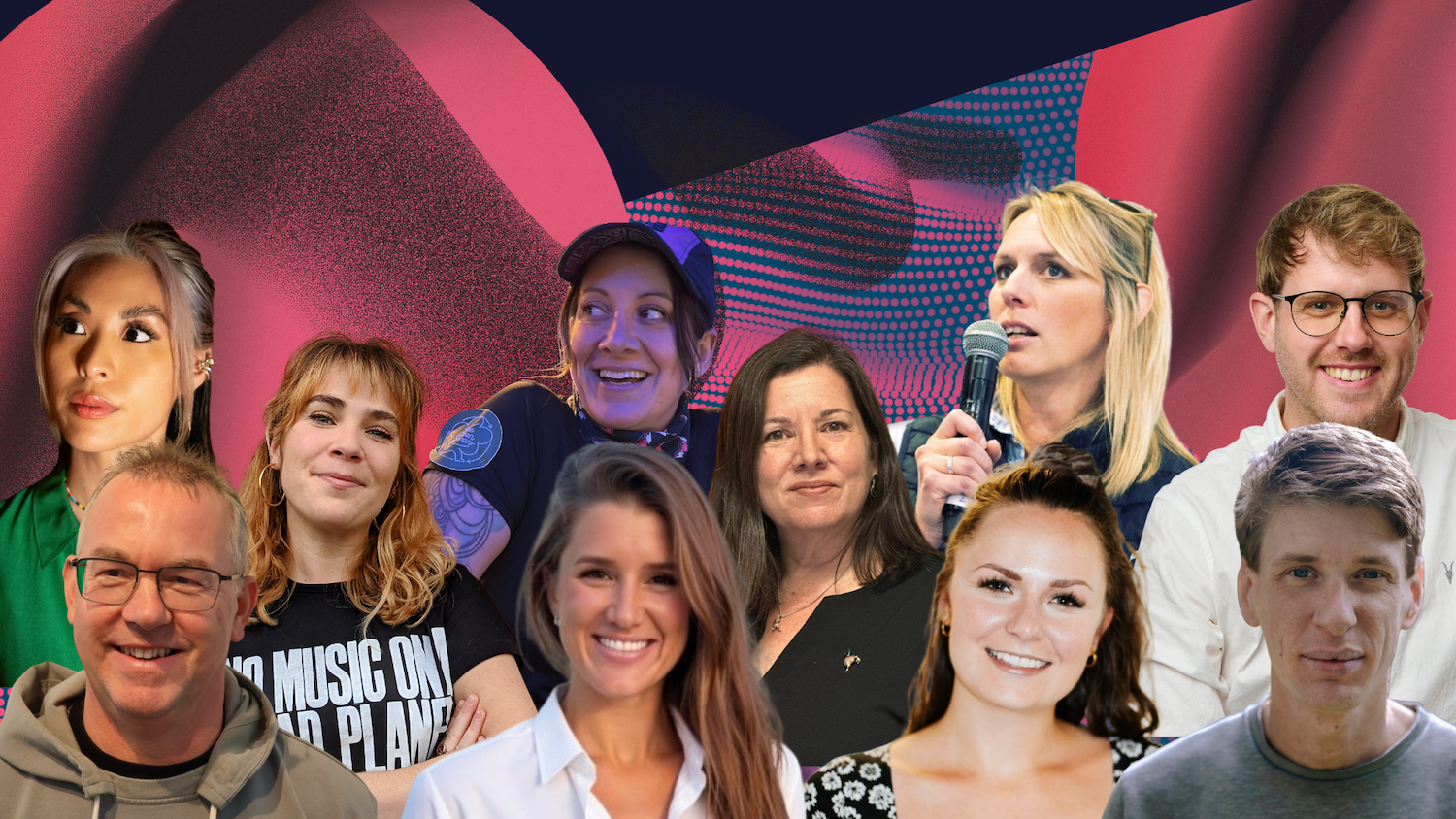
We set out to listen. Here's what we heard.
When we launched The Noise We Make, we had a simple premise: the most important conversations in live events weren't happening on stages or in press releases. They were happening in production meetings, on tour buses, in sustainability reports that nobody read, and in the quiet frustrations of people who had been trying to change things for years.
Ten interviews later, we're not short of insight. But what struck us most isn't any single perspective: it's the pattern beneath them all. A set of tensions that keep surfacing, regardless of whether we're talking to an energy engineer, a communications consultant, a festival CEO, or a climate activist. The music, media and entertainment industry is genuinely changing. But it is changing unevenly, and in some places, not fast enough to outrun the problems it's created for itself.
Here is what we've learned so far…
The data gap is finally closing: and it's about time
For most of live events' history, sustainability has been something the industry felt rather than measured. Decisions about energy, transport, and waste were made on instinct, habit, and a rough sense of what seemed reasonable. The result was a sector that wanted to do better but lacked the shared baseline to know what better actually looked like.
That's beginning to change. The landmark study convened by Hope Solutions with MIT, Live Nation, Warner Music Group, and Coldplay, drawing on data from over 80,000 real events across the UK and US, represents the kind of evidence the industry has always needed and never quite had. It isn't just a report. It's an invitation to stop guessing.
%20(9)-p-1600.png)
What's notable is how quickly real data makes inaction harder to justify. Paul Schurink at Showpower has built his entire practice around this principle: understand actual energy consumption first, then design the system around that reality.
The results are striking, reductions of over 60% in installed capacity, and in some cases no diesel at all on major international shows,
"The most sustainable energy," he told us, "is the energy not being consumed."
It sounds obvious. It is obvious. And yet it represents a fundamental departure from how temporary power has been approached for decades.
The lesson here is this: when you have real data, you can have real conversations. You can push back on assumptions, question inherited practices, and, crucially, demonstrate that doing things differently doesn't mean doing them worse.
In fact, as Schurink's work consistently shows, it often means doing things at a better standard, and with greater cost-effectiveness.
Sustainability built in beats sustainability bolted on
This is perhaps the clearest consensus across all nine interviews: the industry's long habit of treating sustainability as an add-on; something to consider after the creative and operational decisions have been made. It's a fundamental misunderstanding of where the leverage actually sits.
%20(34).png)
Madeleine Smith at Warner Music Group has spent years working on exactly this problem at institutional scale. Her focus isn't the stage, it's the supply chains, the manufacturing, the governance frameworks that determine what's even possible before a single artist steps in front of a crowd,
"Quiet work is where leadership shows up without applause," she told us. "It's the discipline of doing the work credibly without recognition because that's the expectation."
That's a different kind of ambition to the one that announces itself in press releases.
Rob van Wegen, Sustainability Coordinator at ESNS, has arrived at the same conclusion from a different angle. His entire approach at the Eurosonic Noorderslag conference has been to embed sustainability into the DNA of the organisation rather than run it as a parallel programme. Over time, his team has even shifted their language, moving away from "sustainability" toward "future-proof", a term he finds carries more active energy and resonates more broadly across ESNS's network of industry stakeholders. Small shift in framing, significant shift in how people engage.
The same logic applies at the operational level. When energy is designed into an event from the start, when it sits alongside creative planning rather than arriving as a last-minute logistics problem, everything improves. Reliability, efficiency, cost, and yes, sustainability. The point isn't to make events less ambitious. It's to match ambition with intelligence.
What we're describing is a shift in professional culture as much as a shift in practice. And cultural shifts, as anyone who has tried to drive one will tell you, take longer than they should.
Artists are being asked to carry too much
%20(35).png)
Here is something that came up repeatedly, and that we think deserves to be said plainly: the industry has developed a habit of placing sustainability on the shoulders of artists while the systems around them quietly fail to keep pace.
Madeleine Smith named it succinctly,
"Fans are being asked to trust claims they cannot see," she shares, "and artists are often put in the position of carrying messages that the system around them hasn't fully earned yet. That imbalance creates confusion and, ultimately, fatigue."
It's a form of reputational outsourcing, using the credibility artists have built with their audiences to front commitments that haven't been earned operationally. It isn't fair, and it isn't sustainable.
Luke Howell from Hope Solutions put the structural solution clearly,
"Real progress happens when artists, promoters, venues, suppliers, and audiences all see themselves as part of the system, rather than working in isolation."
Luke’s perspective comes from first-hand experience witnessing how meaningful change has actually happened on tours and events.
Another perspective, raised by Pauline Bourdon of Soliphilia (and one we find genuinely hard to argue with), is that the conversation about sustainability in live events cannot be separated from the conversation about how the people who make those events are treated and paid. Financial precarity and bold creative risk-taking don't easily coexist,
"Financial security has the power to change everything," Bourdon told us, "our experience of collective joy, the simple pleasure of making music, and the way we care for one another as an industry."
If the industry wants a sustainable future, it has to be sustainable for the people inside it too.
Perfectionism is actively making things worse
The sustainability conversation has a policing problem. And, while the instinct to hold people and organisations to account is understandable (necessary, even) it has another aspect that several of our interviewees have identified with real clarity.
%20(36).png)
Ruth Dancer of White Griffin works with organisations that are genuinely trying to change, and she watches them hesitate. Not because they don't care, but because they're afraid of being criticised for not doing enough before they've had the chance to do anything,
"I fear that perfection continues to be the enemy of progress," she told us, "whereas we know that behaviour change comes from taking incremental nudges that are celebrated."
The organisations she has seen transform are the ones that were given permission to start imperfectly.
Rob van Wegen puts it even more directly: "Don't let perfect become the enemy of good." His work guiding more than twenty festivals through sustainability roadmaps has taught him that people move at different speeds and from different starting points, and that the role of the sustainability professional is to meet them where they are. "Everyone can take steps of different sizes and at different speeds," he told us. "What matters is that they move forward." He goes further, arguing that the sector needs all types: "the activist, the patient builder, the devil's advocate, and everyone in between." It's a more generous model of change than the one that tends to dominate the public conversation.
Hannah Cox of the Better Business Network comes at this from a slightly different angle, and it's worth holding both perspectives at once. Her concern isn't just that criticism is unproductive; it's that the industry's silence about failure is making the whole conversation less credible,
"We almost never talk about the attempts that didn't work, the targets that were missed, the things that are genuinely hard," she told us. "That silence is making the whole conversation less credible."
Both things are true simultaneously: we need to celebrate progress more generously, and we need to be honest about failure more consistently. The industry needs less performance and more candour.
The social justice dimension is being left out of the room
If there's one area where the gap between where the conversation is and where it needs to be feels widest, it's here.
Xtina Chu of SOLARPUNKS makes the argument that doesn't get nearly enough airtime in mainstream sustainability discussions. Clean energy, she says, isn't primarily an environmental story… it's a power story,
%20(37).png)
The shift to distributed, renewable energy isn't just about reducing emissions. It's about who controls energy, who benefits from it, and who is left vulnerable when supply chains collapse.
Pauline Bourdon raises the same concern from a different angle: the ethics of the minerals that make the green transition possible. Lithium and cobalt don't appear from nowhere. The communities that bear the cost of mining them deserve to be part of a conversation that currently speaks about them without including them.
Rob van Wegen adds an important dimension here too. Empathy, he argues, is one of the most underused tools in sustainability work, and not just in the interpersonal sense. "This kind of empathy also reveals the inequalities we face, and why sustainability is an inherently intersectional topic." Different people and organisations have different capacities, different constraints, and different starting points. Recognising that isn't an excuse for slower progress; it's the condition for making progress that actually holds.
These aren't niche concerns. They are central to whether the transition the live events industry is attempting is genuinely just, or whether it simply shifts the burden elsewhere while congratulating itself on progress.
The industry has enormous cultural reach and real convening power. Using it to widen this conversation would be a meaningful act.
Independent festivals are at risk, and not enough people are saying so
Zac Fox at Kilimanjaro Live said something in her interview that we keep coming back to. After years of building sustainability into Kilimanjaro's operations, the economic shockwaves of COVID and the subsequent surge in supplier costs forced the company to walk some of that progress back,
"Recovery from the COVID years and the subsequent significant increases in supplier costs meant that we have had to reverse some sustainability policies we had established, in order to keep the event viable," she told us.
She suspects she isn't alone in this. We suspect she's right.
The broader point she makes is a cultural one, and it matters. The UK's independent festival sector is genuinely extraordinary: diverse, creative, and deeply embedded in local communities in ways that major festivals simply cannot be. However, it is also precarious.
Fox's call for the kind of sustained public and media attention that has helped protect grassroots venues isn't just an industry lobbying point. It's an argument about cultural value,
"The independent festival world is precarious at the best of times," she said, "and I think it should be fought for in the way that grassroots venues have in recent years. The value to the cultural life of the UK is immeasurable."
What we take away from all of this
%20(38).png)
Nine interviews so far, and we keep coming back to the same tension: the gap between what the industry says and what it does. Not because people are dishonest, everyone we've spoken to is working with genuine conviction. But because the structures, incentives, and habits of a very large and very complex industry are slow to move, and the pressure to appear to be moving is sometimes faster than the movement itself.
Hannah Cox put it most clearly,
"The sustainability conversation is getting louder at exactly the same time as it's getting hollower. More reports, more pledges, more panels and less accountability."
The greenwashing bubble, she believes, will burst.
Lily Batten, whose communications work spans everything from major artist campaigns to the Coldplay/MIT sustainability report, sees the same dynamic from the outside in,
"Quiet, behind-the-scenes work often goes unnoticed, while overstated claims dominate the conversation," she told us.
In an environment where, as she puts it, "misinformation spreads quickly, brands need both honesty and speed", a combination that is harder to achieve than it sounds, and that most organisations are not yet managing well.
We think the industry should get ahead of it rather than wait for the fall.
The good news (and there is real good news here) is that the people doing genuine work are increasingly visible, increasingly connected, and increasingly capable of demonstrating that better is possible. The data exists. The technology works. The business case is real. Rob van Wegen, who has spent years quietly helping organisations navigate this journey, put it with the kind of measured optimism that this moment calls for: "Progress may never move as fast as we would like, and there will be setbacks, but the direction remains forward."
What remains is the harder, slower work of changing how an industry thinks about itself.
That's the noise The Noise We Make exists to amplify. Not the fanfare, but the foundational work: the unglamorous, essential, ongoing labour of people who are building something worth having, long before anyone else can hear it.
The Noise We Make is a Hope Solutions interview series. Read all interviews here.
.jpg)
%20(52).png)