
Curiosity Over Confrontation: Rob Van Wegen on Building Sustainability Into the DNA of Live Events
.png)
“Progress may never move as fast as we would like, and there will be setbacks, but the direction remains forward.”
___________________________________________________________
Every sound tells a story.
The Noise We Make is a Hope Solutions series that listens to the people behind the noise: the artists, organisers, and changemakers using creativity as a force for good. Together, we explore what progress sounds like, and how the choices we make today will echo in the future.
Most sustainability conversations in the live events world focus on what happens on the ground: the power, the waste, the logistics. Rob van Wegen has spent the last few years thinking about something harder to measure, and arguably more important. How do you make change actually stick?
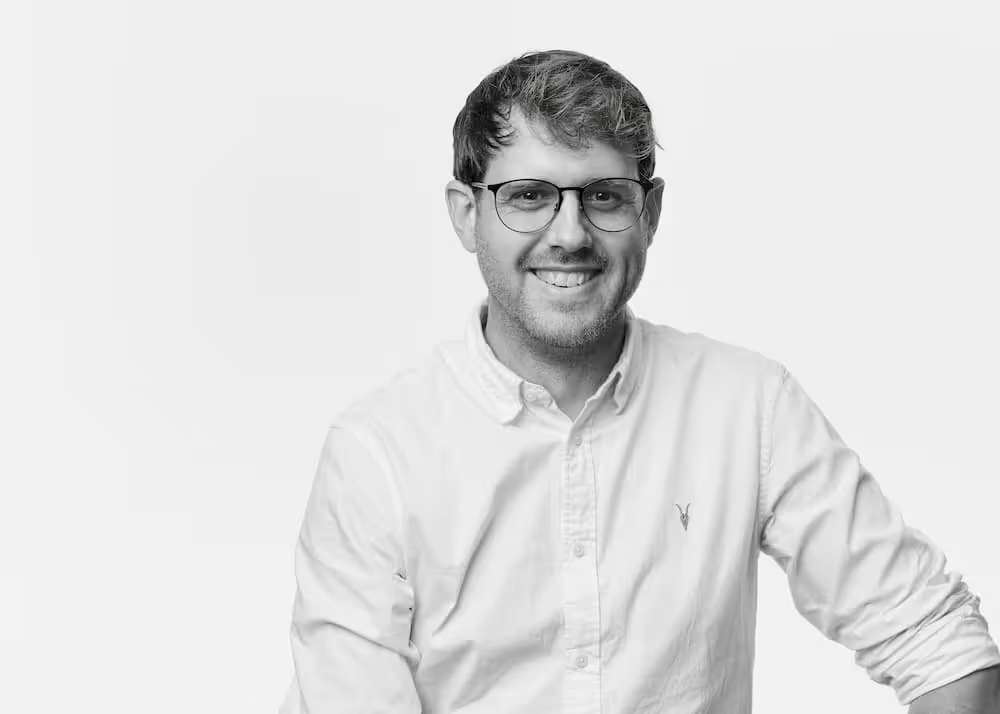
As Sustainability Coordinator at ESNS, Rob brings a rare combination to the work: the practical instincts of a former festival producer and the strategic patience of someone who has learned that behaviour change is the real job. His path took him through five years at Innofest, testing sustainable innovations in live festival environments, before shifting his focus to helping organisations build the structures and strategies that turn good intentions into lasting action. He has personally guided more than 20 festivals through his roadmap canvas, a tool he created to help events translate sustainability ambitions into concrete plans.
At ESNS, Rob's mission has been to embed sustainability into the DNA of the organisation rather than treat it as a programme running alongside the main event. His instinct is not to confront but to connect, not to mandate but to build momentum. As he puts it: curiosity over confrontation.
ESNS (Eurosonic Noorderslag) is one of Europe's most important platforms for emerging music talent, transforming the Dutch city of Groningen into the beating heart of the European music industry each January. Now in its 40th year, ESNS is as committed to shaping the future of the sector as it is to celebrating its richest talent, with sustainability and social impact woven into everything from its festival programming to its industry partnerships, including the Green Deal Circular Festivals and Yourope's Green Operations Group.
So without further ado, here’s Rob’s answers for The Noise We Make…
The Noise You Make: What kind of impact are you (or your organisation) making through your work right now?
At ESNS, our focus is on music industry professionals, sector stakeholders, and emerging artists as the core audience of our event. As a European Showcase Festival and Conference, we bring people together to discuss the future of our industry. Aware that we are part of a larger ecosystem, we actively build connections with our municipality, startup and innovation networks, and supplier communities.
We aim to facilitate positive change by connecting people and presenting sustainability in ways that resonate with our different stakeholders. Everyone can take steps of different sizes and at different speeds, what matters is that they move forward. We support them in making informed choices, so we can all make progress while maintaining a degree of autonomy in the process. We seek to balance the urgency of acceleration with an approach that brings people along, rather than creating resistance.
Beyond dedicated talks on sustainability, we work to embed it into the DNA of our organisation as a whole. This creates broad, lasting influence, even when it isn't immediately visible. Over the years, we have shifted our language toward the term "future-proof". We feel it carries a more active energy and resonates better with our network. It encompasses social, environmental, and governance dimensions alike. We push forward by continuing to ask each other questions, developing roadmap tools to offer support, and building on existing collaborations. Listening carefully to the needs of others is a crucial part of this. As I often describe our approach: curiosity over confrontation.

The Noise You Hear: What signals, movements, or shifts in the industry are catching your attention?
In recent years, I have noticed a shift in where attention falls within sustainability. There was a peak of interest in environmental sustainability, followed by a wave of focus on social sustainability, and now the spotlight seems to have moved to governance. I believe this is a natural progression. Looking back, I feel we have taken three steps forward and one step back, and that is alright. The broad commitment to the topic is still very much alive. Many organisations have picked it up and acknowledged their responsibility. Progress may never move as fast as we would like, and there will be setbacks, but the direction remains forward. We need to keep our spirits up and continue pushing in a well-considered manner. Both forward, to develop new solutions, and sideways, to reach out and join forces as an industry and grow the movement together. We will keep nudging for a new wave of interest, one that carries a genuinely future-proof mindset.
I also sense that some people have become more polarised around sustainability, caught between the urgency of doing good and the pace at which others are willing to move. Yet we all have a role to play: the activist, the patient builder, the devil's advocate, and everyone in between. Which brings me to my second one-liner: don't let perfect become the enemy of good. Do what works best for your context and your capacity, but stay kind to those who are finding their own path forward.
The Noise That Needs to Change: What’s still too loud, too quiet, or missing altogether in the sustainability conversation?
Empathy, the ability to perceive another person's perspective, is a powerful force in sustainability work. It means looking for solutions from the perspective of the person you are trying to help. When we make the effort to see the world from another's position, we expand our own understanding and develop patience for where they are in their journey. This doesn't require agreement, but understanding allows us to offer the support others actually need, rather than the support we think they should want. By truly listening, we can find solutions that serve both the sustainability goals we share and the real circumstances people are in.
This kind of empathy also reveals the inequalities we face, and why sustainability is an inherently intersectional topic. We should acknowledge the different capacities that people and organisations have, and push for progress within those limits, but those limits are not the same for everyone. Privilege comes with accountability. I am aware that this is easy for me to say, working in this field from the Netherlands, with the time and space to think deeply about these issues. That is precisely why I feel a responsibility to support others in their own journey.
We have access to new technologies and well-organised public transport, yet I also see a culture of discarding materials long before they are worn out, feeding a cycle of overconsumption. There is much we can learn by looking beyond our own context and drawing inspiration from others.
I keep returning to the same questions: Why do I act the way I do? How can we do less harm? How can I switch to a more sustainable alternative? And how can I do this more efficiently? In that order.
None of what is written here is new, and I want to acknowledge that. Respect and gratitude go to everyone whose work came before mine and helped shape my thinking. I hope to offer the same to others in return. Sustainability roles are reportedly among the fastest-growing in the job market, which means we need enough well-equipped people working in this space. If we can help them avoid reinventing the wheel, they will be able to do more good, far more quickly.
The Quiet Work: What behind-the-scenes actions make the biggest difference?
Some people have been working in this field for a very long time, starting far ahead of the curve, often without much recognition. Their perseverance paved the road for the rest of us and made it possible to take the next steps.
The long haul, the patience, continuity, and quiet perseverance this work demands, is not always recognised or celebrated. It is slow, rarely headline-worthy, and can seem less visible than bold new initiatives. But it is just as essential. A diversity of approaches is needed, and we need many of them moving forward together. In the end, we all have a role to play.
The Next Sound: What’s next for you? What sound would you love the future of live events to make?
I believe change management is at the heart of this work. As I often say, 80 to 90 percent of what I do is about managing change, far more than it is about subject-specific knowledge. That knowledge can be found, and thankfully there are wise and experienced people to turn to. But getting others into a position where they want that knowledge and are ready to act on it, that is where the real work lies. It is why I find myself reading more and more about what behaviour change and change management experts have to say, and how their insights can help.
For some time now, I have also been exploring the concept of the handprint, trying to get a clearer sense of the impact we can have by reaching out to and influencing others. Alongside gut feeling, I hope to ground this in research and measure that impact more concretely. I believe this connects closely to the theory of constraints. If we can remove small but stubborn barriers at the points where change is hardest, we create flow and momentum. This can significantly accelerate the journey from innovators and early adopters through to the early majority. And that is when truly significant change becomes visible.
When we reach people at scale and cultivate a collective sense of responsibility, I believe there is an enormous amount we can achieve together.
___________________________________________________________
Connect with Rob on LinkedIn.
Discover more about ESNS on their website or:
.jpg)