
The Sun Also Powers: How Xtina Chu Is Making Clean Energy a Cultural Movement
.png)
“When disaster strikes and fuel supply chains collapse, solar keeps running.”
___________________________________________________________
Every sound tells a story.
The Noise We Make is a Hope Solutions series that listens to the people behind the noise: the artists, organisers, and changemakers using creativity as a force for good. Together, we explore what progress sounds like, and how the choices we make today will echo in the future.
Christina “Xtina” Chu is building a new kind of energy movement: one that doesn’t start in policy, but in culture.
As Co-Founder and Executive Director of SOLARPUNKS, a nonprofit advancing clean energy across creative industries, Xtina sits at the intersection of art, music, technology, and climate action. Her work doesn’t just imagine a lower-carbon future, it prototypes it in real time, embedding renewable energy into the spaces where culture is created and experienced.
Since 2022, SOLARPUNKS has delivered clean energy across an extraordinary range of projects: from powering Burning Man’s first utility-scale solar installation to supporting disaster relief in Los Angeles, enabling low-carbon music performances at SXSW, and collaborating on art, fashion, and film projects with partners including Rivian, Nike, Getty PST, and Universal. Each activation acts as both infrastructure and storytelling, demonstrating what’s possible while inviting others to participate.
Xtina’s approach is shaped by a background in cultural strategy, including years spent at Red Bull crafting music-led brand platforms. That experience now underpins her belief that the energy transition isn’t just a technical challenge, it’s a cultural one. By creating visible, tangible examples in culture-forward spaces, she’s helping shift perception, accelerate adoption, and democratise access to clean energy.
At its core, her work is about movement-building: bringing together artists, corporations, technologists, and communities to reimagine how energy is generated, shared, and experienced.
Because when clean energy becomes part of culture, not just infrastructure, it has the potential to scale far beyond expectation.
So, let’s explore the noise Xtina Chu is helping to make…

The Noise You Make: What kind of impact are you (or your organisation) making through your work right now?
SOLARPUNKS exists because the clean energy transition has an adoption problem, not a technology problem — the solar panels and batteries work, but deployment requires proving it's possible, convening communities to share knowledge, and devising business models that make expensive infrastructure accessible.
We (1) Test and prove technology in culture-forward playgrounds — festivals, creative gatherings, art installations — where people experience clean power firsthand and build the mindshare that makes adoption feel inevitable, and (2) Leverage that mindshare to bring decision-makers together — across culture, engineering, finance, and policy — to devise new models that increase utilisation and democratise access.
For example, we’re currently advancing the concept of mobile, solar-based microgrids. In other words, redeployable clean energy systems that serve multiple deployments per year instead of one permanent grid-connected installation. This effectively makes the high upfront cost of hardware more affordable and accessible.
To demonstrate this application, we recently gifted Burning Man participants with a utility-scale clean energy power plant that provided free clean electrons (24/7) to power art, EVs, large camps, e-bikes, phones and more.
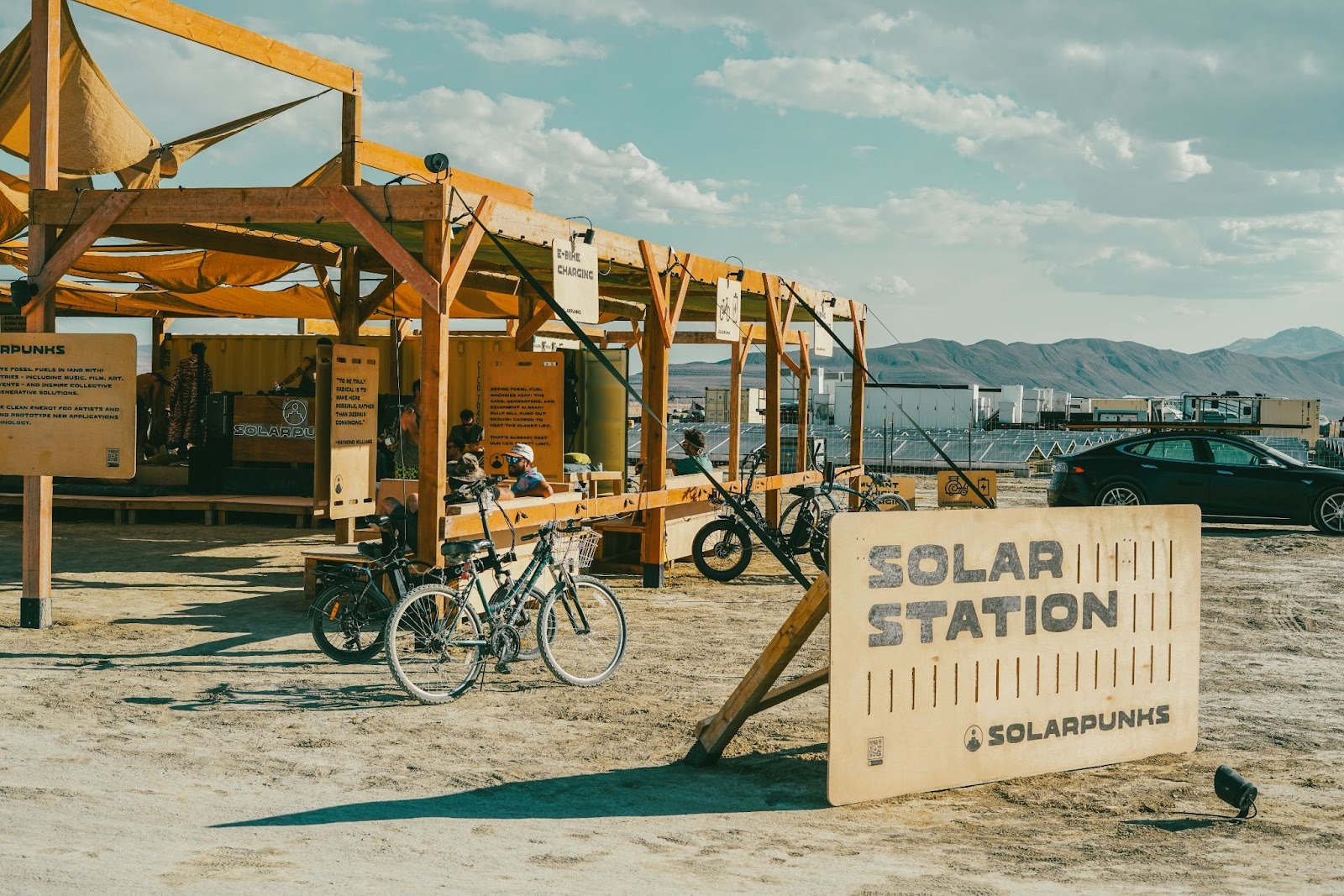
This demonstration not only served as a field test for displacing large diesel generators with solar-powered batteries across disaster relief, festivals, construction sites, film productions and more, but also to convene a community of cultural, technical and financial engineers to translate proof points from culture-forward spaces into applications across industries.

The Noise You Hear: What signals, movements, or shifts in the industry are catching your attention?
The signal we keep hearing across industries: speed is the new premium, and clean energy is becoming the fast option, whether it's for datacenters racing to deploy AI infrastructure or disaster response needing dependable power in hours, not months.
Traditional energy infrastructure (grid interconnection) is designed for 5-year+ timelines while off-grid solar and battery can deploy in hours.
What's fascinating is watching different industries discover the same solution independently: festival producers choosing it because they’re silent and emissionsless, datacenter developers choosing it because it bypasses interconnection queues, disaster response choosing it because fuel supply chains fail in emergencies — they're all converging on batteries-plus-solar for completely different reasons, which tells us this isn't niche anymore.

The Noise That Needs to Change: What’s still too loud, too quiet, or missing altogether in the sustainability conversation?
Too loud: Sustainability framed ONLY as environmental protection — saving nature, reducing emissions, preserving ecosystems.
Too quiet: Sustainability framed also as human protection — energy sovereignty, economic resilience, freedom from dependency and violence.
Fossil fuels are a non-regenerative commodity that create dependency by design: communities can't generate their own oil, they must buy it from someone else, which creates leverage, volatility, and violence.
Look at the geopolitical climate — wars fought over oil fields, fuel price shocks that devastate economies, entire regions held hostage by supply chains that can be weaponised.
Clean energy — when it's distributed, benefits communities, and is regenerative — fundamentally changes the power dynamic. When you can generate power from the sun, you're not dependent on global markets or geopolitical conflicts. When disaster strikes and fuel supply chains collapse, solar keeps running.
The conversation we're not having is: fossil fuel infrastructure was designed to extract value from communities and concentrate it elsewhere. Clean energy infrastructure could be designed to do the opposite — to create sovereignty, resilience, and equity. That's the sustainability that matters for humans.

The Quiet Work: What behind-the-scenes actions make the biggest difference?
The biggest behind-the-scenes work? Recognising that human energy matters as much as electrical energy. People won't choose clean energy just because it's a new technology or cheaper — they'll take a risk when they trust the co-sign. When an artist demands it. When a festival proves it works. When a community vouches for it.
So the quiet work is building that trust by getting people into rooms who don't normally talk: infrastructure developers who operate on 15-20 year timelines sitting with festival producers who work month-to-month, utilities meeting disaster responders, investors collaborating with creative communities.
When these groups connect, they pioneer new models — the infrastructure developer learns deployment speed from the festival producer, the festival producer learns financial structuring from the investor. They inspire each other and co-design solutions neither could imagine alone.
The quiet work is using cultural currency to accelerate adoption where market forces alone move too slowly. When artists demand clean power and audiences experience it, when festivals prove it and producers adopt it, when communities demonstrate it's possible and investors fund it — trust compounds, cultural permission spreads, and the infrastructure follows.

The Next Sound: What’s next for you? What sound would you love the future of live events to make?
What's next is translating proof points from culture-forward experimentation into mainstream reality — festivals, construction sites, disaster response — building the community infrastructure so knowledge flows between industries and every deployment makes the next one easier.
The sound I want the future of live events to make is silence. Not literal silence — music should still be loud — but the silence where diesel generators used to drone, where exhaust used to drift, where combustion used to pollute.
I want these gatherings powered by the abundant and accessible energy of the sun, because gatherings are the fundamental building blocks of culture — and culture is how we can accelerate the adoption of technologies that can create equity: with nature, and with each other.
___________________________________________________________
Discover more about SOLARPUNKS via their website and Instagram

.jpg)