
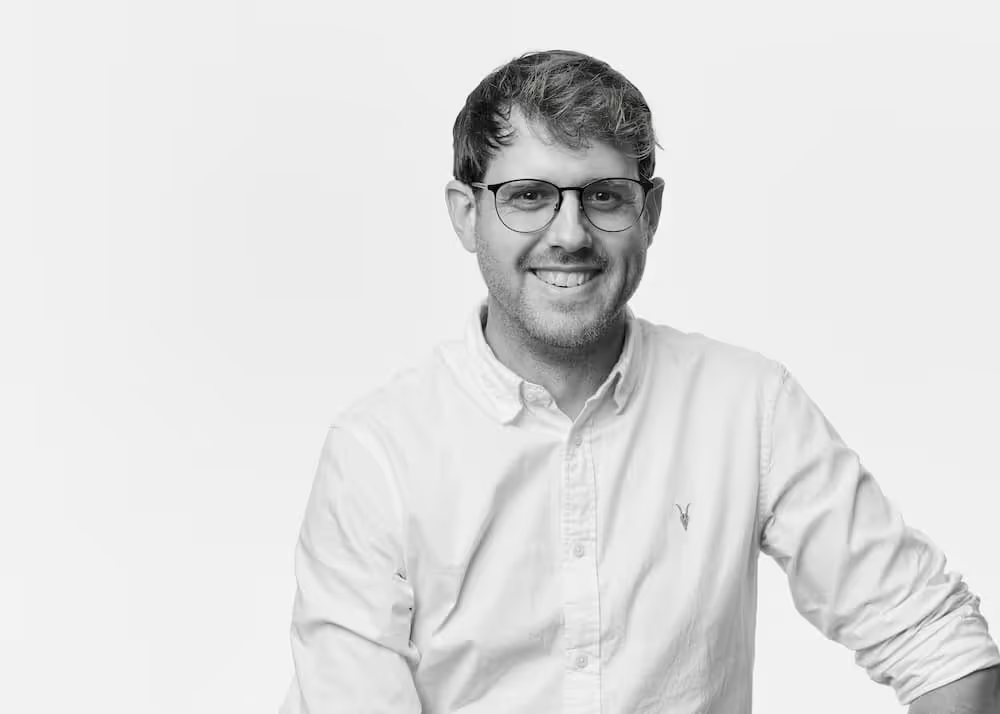
The Noise We Make: Paul Schurink on Rethinking How Live Events Are Powered
.png)
“It is not one big decision that makes a difference. It is hundreds of small, informed decisions made early enough to matter.”
___________________________________________________________
Every sound tells a story.
The Noise We Make is a Hope Solutions series that listens to the people behind the noise: the artists, organisers, and changemakers using creativity as a force for good. Together, we explore what progress sounds like, and how the choices we make today will echo in the future.
Paul Schurink has spent more than two decades powering some of the world’s biggest moments.
From the Olympic Games to global stadium tours and major international festivals, his work has sat at the heart of live events where scale, precision, and reliability are non-negotiable. But today, the question isn’t just how to power these moments, it’s how to power them differently.
As Co-Founder of Showpower, Paul is helping to redefine how energy is designed and delivered across live events, broadcast, and touring. A specialist in temporary power systems, he combines deep technical expertise with a clear focus on sustainability, leading the shift away from diesel generators towards smarter, lower-carbon alternatives.
Known in the industry as both an innovator and a problem-solver, Paul’s work spans energy assessment, measurement, battery systems, and the design of intelligent “smart power plans” that optimise performance while reducing emissions. His experience includes projects with Coldplay, Glastonbury, Lollapalooza, UEFA European Championships, and The Ocean Race, placing him at the forefront of the energy transition within live entertainment.
What sets Paul apart is his ability to translate complex energy systems into practical, deployable solutions: proving that sustainability doesn’t have to come at the expense of performance, but can enhance it.
Because when you rethink how events are powered, you don’t just reduce impact, you change what’s possible.
So, let’s explore the noise Paul Schurink is helping to make…

The Noise You Make: What kind of impact are you (or your organisation) making through your work right now?
At Showpower, we are fundamentally changing how energy is designed and delivered for live events.
For decades, temporary power has been approached as a logistical afterthought — generators hired, fuel delivered, and systems oversized to manage risk and as a part of the existing business model. We think differently. We design energy systems holistically, starting with understanding the real power requirement, and then building the most efficient solution around that — reducing energy consumption, prioritising grid connections, integrating battery systems, and minimising or eliminating diesel altogether.
The impact is significant. We are seeing reductions of over 60% in installed capacity and in the right scenarios reducing the running generators to zero on major international shows. But what is equally important is that we often reduce costs at the same time.
That is the shift we are trying to make — proving that better energy design is not just environmentally positive; it is a smarter operational and financial one.
It’s about giving the industry confidence that change is not only possible, but beneficial by future-proofing events at the highest level.

The Noise You Hear: What signals, movements, or shifts in the industry are catching your attention?
The biggest shift I see is a growing willingness to question the status quo.
There is a recognition now that the traditional diesel generator model is inefficient by design. People are starting to look more closely at their actual energy use, rather than simply installing capacity based on habit or precedent.
Once teams are empowered to understand a bit more about their energy consumption, they can start to ask their power suppliers and providers questions instead of just paying the bill after the event has finished.
We’re also seeing leadership emerging from unexpected places — artists, production directors, and organisers who want to do things differently, not just for sustainability reasons, but because they see the operational advantages for their businesses, and marketing and engagement advantages for their audiences.
At the same time, there is still a degree of disbelief, hesitancy, and negativity. We have been conditioned to expect that sustainability comes with compromise, loss and / or additional cost, perhaps because we are used to threatening or doomsday messages of “we need to save the planet / the polar bears / the ice caps…”
Not to ignore those important actions, but what if we can reduce emissions and reduce cost simultaneously, and it can be positive, uplifting and creatively impactful… We want to challenge long-held assumptions and do things because there are better ways to do things and it can be more efficient and sustainable. After all, the most sustainable energy is the energy not being consumed….
That mindset shift is happening, but it takes time. Trust is built through experience.
The Noise That Needs to Change: What’s still too loud, too quiet, or missing altogether in the sustainability conversation?
What has been too loud historically is the focus on technology in isolation — batteries versus generators, diesel versus electric, plastic vs recyclable.
It is helpful to highlight the problems in isolation, but the real opportunity lies in system design. And it is no different with power.
Energy efficiency is the most powerful and most overlooked lever we have. Before you change the source of energy, you need to change how intelligently it is used.
What has also been too quiet is the operational and financial benefit to all stakeholders involved in the mix. Sustainability is often framed as a moral obligation, which it is — but it is also an efficiency opportunity. When you remove waste, you reduce fuel, equipment, transport, and cost.
What is missing is confidence. Confidence that there is a better way, and that it works at scale.
That is what the industry needs now — proof, and the willingness to rethink established practices.

The Quiet Work: What behind-the-scenes actions make the biggest difference?
The biggest impact comes from work that most people never see.
It is getting the right people around the table to discuss the challenges. It’s analysing energy data in detail. It’s questioning assumptions about what is needed. It is collaborating closely with management and production teams for months or years in advance, rather than days or weeks before the show.
It is also about integrating energy into the creative and operational planning process, rather than treating it as a standalone service.
When energy is designed properly from the outset, everything improves — efficiency, reliability, cost, sustainability…. And in the case of using batteries for stage services, power quality, audio, and A/V quality is near perfect. Audio engineers love battery power because there is next to no interference.
It is not one big decision that makes a difference. It is hundreds of small, informed decisions made early enough to matter.

The Next Sound: What’s next for you? What sound would you love the future of live events to make?
I would love energy to become quiet and invisible in the best viable way.
Not invisible because it is ignored, but invisible because it has been solved — intelligently designed, highly efficient and no longer dependent on fossil fuels.
We’re moving toward a future where events are powered primarily by grid connections and where batteries enable reliability and perfect power quality, integrated with renewable energy.
In that future, diesel generators will become the exception and stand-by charging options only, not the default.
More broadly, I hope the future sound of live events is one of confidence — confidence that this industry, which brings people together in such powerful ways, can also lead by example.
Live events have always shaped culture. Now they can help shape a more sustainable way of operating and delivering the most high-profile and exciting events worldwide.
That is an exciting place to be.
___________________________________________________________
Connect with Paul on LinkedIn.
.jpg)