


Why We Went Quiet at the Loudest Night in Music

In the weeks leading up to the BRIT Awards, you may have noticed something… off.
Social posts that felt… unusual. Visuals that looked… askew. Moments where action seemed to drop out altogether.
That wasn’t a glitch. It was deliberate.
On the night of the BRIT Awards, one of the loudest, most influential moments in the music calendar, we placed a simple ad in the event programme.
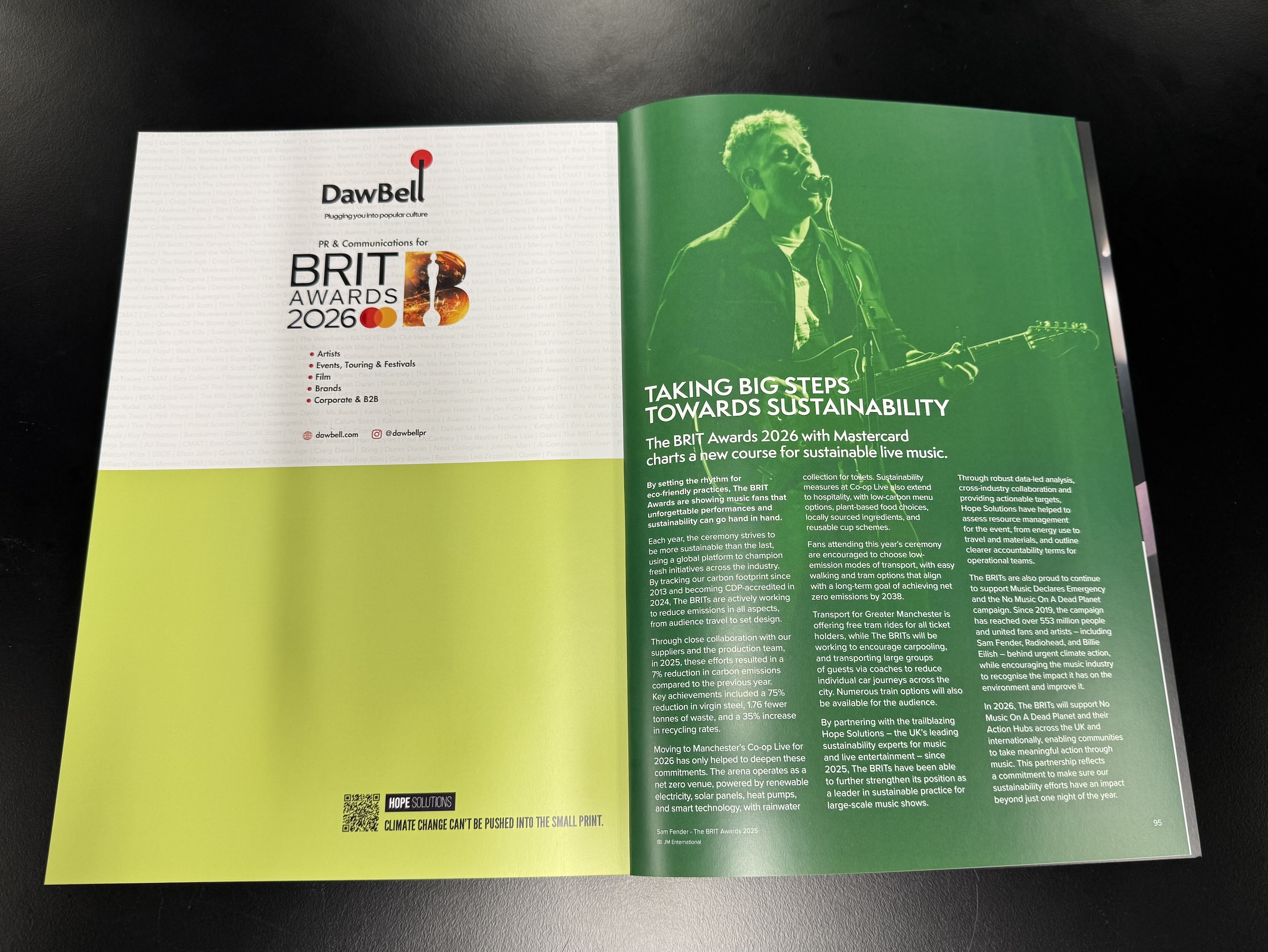
Because sometimes the most effective way to be heard is to stop adding to the noise.
And in this article, we’re going to explain exactly why.
Why did we do it?
Live music is brilliant at celebration and spectacle, but it’s far less comfortable with what happens beyond the applause.
For years, sustainability in live music has been shaped by intention rather than evidence: acknowledged late in the process, once tours are routed, venues are booked, and production decisions are already locked in. By then, the biggest drivers of environmental impact have been set, and the opportunity for meaningful change has largely passed.
That reality is now backed by data.
Recent collaborative research from the MIT Climate Machine, Hope Solutions, Live Nation Entertainment, Warner Music Group and Coldplay, shows that the majority of live music emissions are driven by early planning decisions. Travel alone accounts for the largest share of impact across both the UK and US, followed by energy use, food, materials and infrastructure.
In the UK, the newly launched third edition of The Show Must Go On report (SMGO) reinforces the same message. Built through industry-wide collaboration across festivals, events and suppliers, it sets out a Climate Transition Plan to 2030 - with clear benchmarks, practical actions and policy recommendations designed to align the live events sector with national net-zero targets.
The direction of travel is clear: the industry is mobilising. But evidence and roadmaps only change outcomes when they influence decisions early enough.
These are not end-of-show fixes. They are choices made long before the first note is played.
Our campaign was designed to reflect what happens when sustainability arrives too late.
The absence.
The silence.
The crossed-out action.

It’s the gap between ambition and execution: between what the industry says it wants to do, and what actually gets planned when time, budgets and momentum take over.
At Hope Solutions, our work exists in that gap. We help artists, tours, festivals and cultural events bring evidence, data modelling and real-world experience of sustainable solutions into the earliest stages of planning, when sustainability can still shape outcomes, not just report on them.
Because reducing the impacts of climate change doesn’t fail due to lack of intent.
It fails when it’s treated as an afterthought.
“Live music knows how to celebrate. What it struggles with is what comes after. This campaign was a pause: a reminder that if sustainability isn’t planned in from the start, it disappears from the outcome.”
Luke Howell, Founder, Hope Solutions
Why the BRIT Awards mattered
On Saturday, 28 February 2026, the biggest night in live music in the UK took place at Co-op Live in Manchester. But what made this year's BRIT Awards significant wasn’t just where it happened: it was how the event was designed and delivered. For more than a decade, the BRITs have been measuring their environmental impact, reducing emissions year on year, and using their platform to push sustainability higher up the industry agenda.
This year marked a clear step forward. With a new sustainability strategy, CDP accreditation, and a venue powered by 100% certified renewable electricity, the BRIT awards demonstrated what it looks like to take climate action seriously at scale. From transport planning and waste reduction to food sourcing, materials and supplier engagement, sustainability was treated as a core part of delivery, rather than an add-on once decisions were already made.
It’s an approach that recognises a simple truth: impact is shaped early.
And it’s precisely because the BRIT Awards are already doing this work, and because they set the tone for the wider industry, that this moment mattered.
By choosing to create a pause in that moment, we weren’t rejecting celebration. We were asking a single, urgent question:
What legacy are we leaving behind when the lights go out?
The applause and accolades shine on the night itself. But the longer-lasting impact, on climate, communities, and the world we live in, doesn’t disappear once the broadcast ends.
That’s why this campaign reflects where the industry is right now: there’s no shortage of ambition, but too little action happening early enough to properly change the outcome.
And because the BRIT Awards sets the tone for what comes next in music, it was the right place to ask this very question.
The reality behind the silence
The BRIT Awards is a single night in the calendar year, but what it represents is much bigger.
Behind the performances, production and broadcast sits a vast, temporary system: artists, crews and audiences moving across the country and beyond; equipment and staging built, transported and dismantled at pace; energy use at scale; materials specified, consumed and discarded: all to deliver a few hours of live spectacle.
This is live music at its most concentrated. And it’s exactly why moments like the BRIT Awards matter.
What the research makes clear is that the environmental impact of live music isn’t evenly spread, and… it isn’t inevitable. Large, high-profile events may be fewer in number, but they generate a disproportionate share of emissions. That also makes them some of the most powerful leverage points for change.
The critical insight isn’t simply that live music has an impact. It’s where and when that impact is shaped.
The biggest drivers of emissions are determined long before a show reaches the stage: how events are planned and routed, how audiences are expected to travel, how power is provided, and how production, food, freight and materials are specified. These decisions are made upstream, well before sustainability is typically brought into the conversation.
This is where silence creeps in.
Not because people don’t care.
But because by the time sustainability enters the room, the familiar rhythm of delivery has already taken over.
At a moment like the BRIT Awards, where influence, attention and ambition converge, that silence is amplified. The industry celebrates the outcome, while the decisions that shaped its impact remain invisible.
And when sustainability arrives late, it becomes harder, more expensive and less effective. It turns into reporting, mitigation or explanation, rather than design.
This is the space we work in, translating evidence into early, practical decisions that fit the realities of live events. Not abstract ambition, but timing, coordination and delivery.
Because silence isn’t a failure of intent.
It’s a failure of inaction.
What Hope Solutions does differently
As long-time partners to the live music and events sector, we’ve seen the same pattern repeat itself: sustainability teams brought in once operational plans are finalised, asked to measure impact after the fact, and left trying to retrofit solutions into decisions that were never designed with impact reduction in mind.
That’s not a failure of ambition.
It’s a failure of timing.
Our work focuses on the point where decisions are still fluid, when routes can be adjusted, production designs refined, power and energy strategies reconsidered, and audience journeys rethought.
This is where evidence, modelling and data stop being theoretical and start shaping outcomes in the real world.
We partner with artists, tours, festivals and cultural events to:
- Understand environmental impact before decisions are fixed, using sector-specific data and modelling rather than assumptions
- Design climate change strategies that are practical, measurable and achievable, grounded in how live events actually operate
- Move beyond pledges and reporting, translating ambition into delivery across touring, venues, logistics and supply chains
Because sustainability doesn’t succeed through good intentions alone.
And it doesn’t survive as a footnote.
It only works when it’s built into the brief.
A call to the industry
Live music has always been a cultural force.
Now it needs to be a responsible one.
For the first time, this industry has a shared, credible understanding of its environmental impact, grounded in real data, real events, and real-world operations. What comes next isn’t more intention, or louder promises. It’s earlier action.
Sustainability can’t sit on the sidelines. It can’t be deferred to post-event reports. And it can’t survive as a footnote.
If live music is to continue inspiring audiences around the world, it must be built differently, with climate considerations embedded from the very first brief, not added once the lights go out.
The show can go on.
But only if we change how it’s made.

.jpg)